
Table of Contents
🌊 Fishermen, Their Lives, and the Challenge of Marketing Their Catch
Fishing has been a way of life for millions of families around the world — a tradition passed down through generations. Fishermen brave unpredictable seas, long hours, and harsh weather, often starting their day before dawn and returning only after sunset. Their livelihoods depend on nature’s mercy — tides, seasons, and changing marine patterns — all of which are becoming more uncertain due to climate change.
Behind every fresh fish that reaches our table lies a story of endurance, skill, and risk. Fishermen invest in:
- Boats, nets, and fuel, which are becoming costlier each year.
- Navigational equipment and ice storage, often beyond their means.
- Physical labor that demands strength, patience, and resilience.
Despite their hard work, most fishermen are small-scale operators, selling through middlemen or local agents who control prices and access to markets. Without real-time information, fishermen often:
- Sell their catch at low prices just to avoid spoilage.
- Lose income due to gluts in the local market.
- Are unable to connect with restaurants, hotels, or direct consumers who value freshness and quality.
The result is a broken value chain — where fishermen earn little, consumers pay more, and enormous amounts of seafood go to waste.
⚓ The Marketing Difficulties Fishermen Face
- Lack of Market Access:
Remote coastal or island communities often have no digital tools to reach inland buyers or markets. - Perishable Nature of Catch:
Fish and seafood spoil quickly without cold storage or immediate sale. Unsold catch means direct loss. - Price Manipulation by Middlemen:
Fishermen frequently have no bargaining power and must accept the day’s lowest offer. - Unpredictable Demand:
Fishermen don’t know which species are in high demand or where — leading to mismatched supply and waste. - Logistical Limitations:
Transporting fresh fish inland requires expensive cold-chain systems, which small-scale fishers can’t afford.
🐟 Food Pulse: Empowering Fishermen, Reducing Waste, and Building Fair Trade
Food Pulse introduces a digital revolution in the seafood ecosystem — a real-time fish marketplace designed to connect fishermen directly to buyers, restaurants, and retailers with transparency and trust.
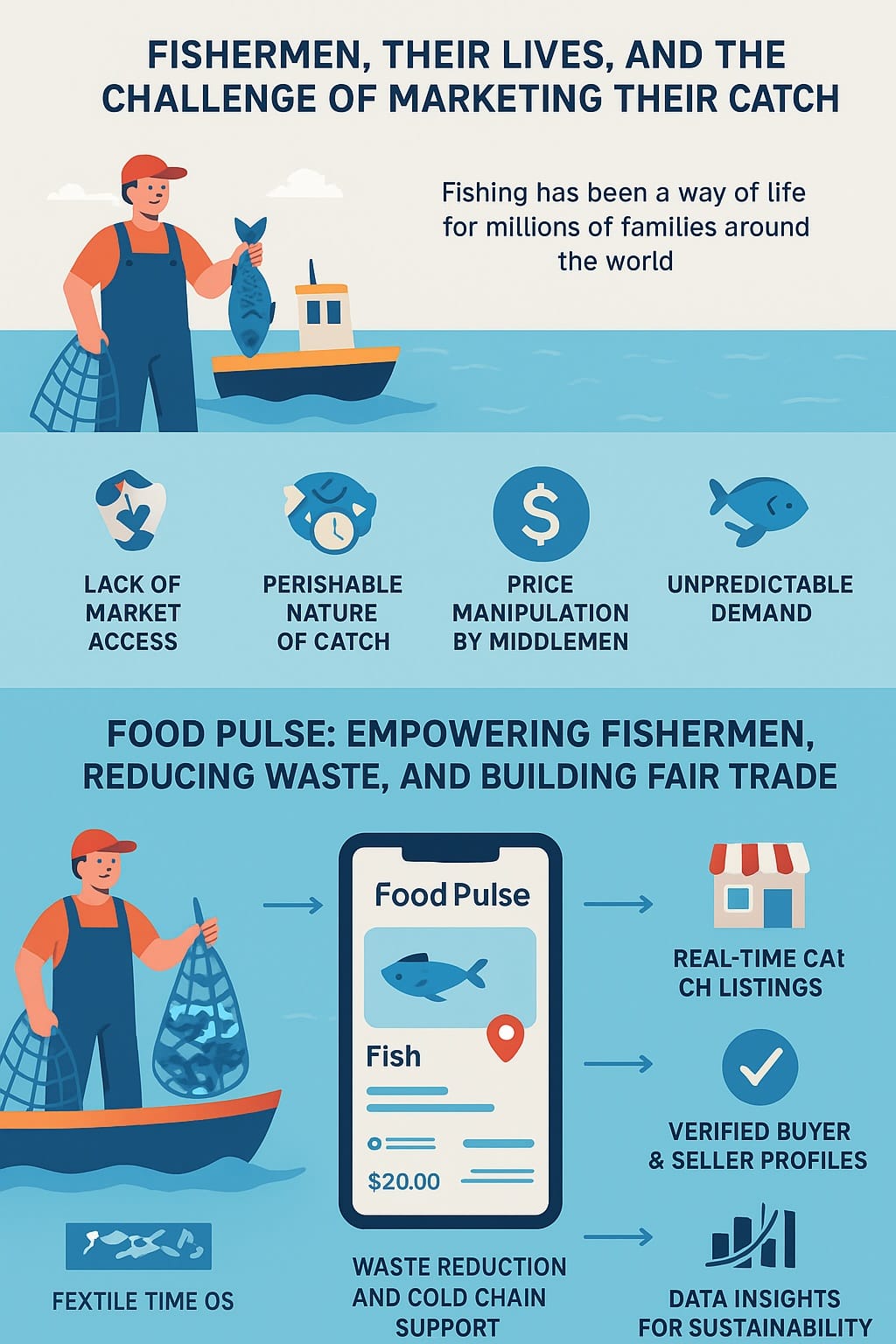
🔹 1. Real-Time Catch Listings
Fishermen can instantly post their daily catch using the Food Pulse app:
- Upload photos of fish or seafood.
- Specify type, weight, freshness level, and price.
- Pin their exact location using GPS.
- Add availability time and delivery/pick-up options.
This lets buyers see what’s available as soon as it’s caught, creating a live marketplace for the freshest seafood.
🔹 2. Smart Matching & Alerts
Food Pulse uses AI-powered algorithms to:
- Match fishermen’s listings with restaurants, markets, and consumers nearby.
- Send instant notifications when a desired species becomes available in real time.
- Recommend optimal pricing based on market trends, helping fishermen negotiate better.
🔹 3. Verified Buyer & Seller Profiles
All users — fishermen, buyers, and distributors — have verified profiles.
This builds trust and accountability, ensuring that fishermen deal directly with genuine buyers without being exploited.
🔹 4. Waste Reduction and Cold Chain Support
Through partnerships with:
- Cold storage providers,
- Local cooperatives, and
- Charities or fish processing centers,
Food Pulse can ensure that unsold or excess catch is frozen, processed, or donated rather than wasted. Even small fish or offcuts can be converted into dried products or fish meal.
🔹 5. Data Insights for Sustainability
Food Pulse’s dashboard helps track:
- Daily catch volumes
- Regional demand trends
- Seasonal fish availability
This data not only helps fishermen plan their trips wisely but also supports sustainable fishing practices and government monitoring of overfishing risks.
🔹 6. Community Empowerment
By connecting fishing communities with:
- Training on pricing and quality standards,
- Access to microfinance, and
- Digital literacy support,
Food Pulse uplifts entire coastal economies. Fishermen become entrepreneurs, not just laborers.
🌍 Impact and Vision
With Food Pulse:
- Fishermen get fair prices and instant market visibility.
- Consumers enjoy fresher seafood with traceable origin.
- Less food is wasted, reducing the environmental footprint of fishing.
- Coastal communities thrive with dignity and stability.
Ultimately, Food Pulse turns the age-old act of fishing into a digitally connected, sustainable, and fair trade ecosystem — where every catch counts, every effort is valued, and every meal tells a story of respect for the sea and those who work upon it.
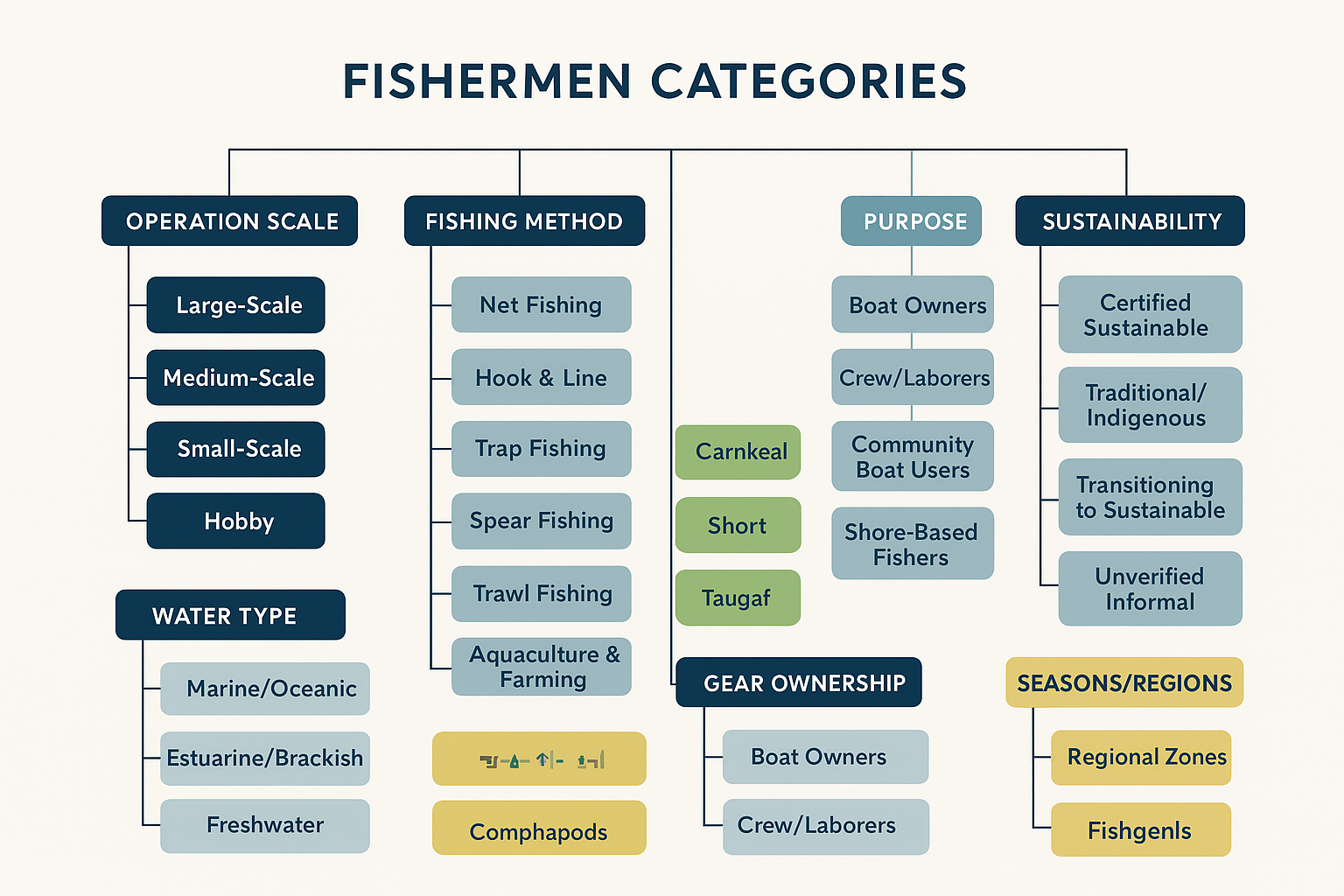
🗂 Fishermen Categories & Subcategories for Food Pulse Database
1. By Operation Scale
| Category | Description | Example |
|---|---|---|
| Large-Scale / Commercial Fishermen | Operate trawlers or large boats, supply to wholesalers, markets, or export. Often use industrial equipment and crews. | Deep-sea fleets, commercial trawlers |
| Medium-Scale Fishermen | Operate regionally with mechanized boats, selling directly to markets, hotels, and restaurants. | Regional fishers, cooperative members |
| Small-Scale / Traditional Fishermen | Use manual or semi-mechanized boats, fish close to shore or rivers. Family or community-run. | Coastal, lagoon, or estuary fishers |
| Hobby / Recreational Fishermen | Fish for sport, leisure, or personal consumption. May still sell surplus catch locally. | Anglers, weekend fishers |
| Community / Cooperative Groups | Fishing groups sharing boats, resources, and profits. Often linked with NGOs or local councils. | Fishermen’s cooperatives, women’s groups |
2. By Fishing Method
| Category | Subcategory | Description |
|---|---|---|
| Net Fishing | Gill Net | Stationary net that traps fish by gills |
| Cast Net | Circular net thrown manually from shore or boat | |
| Seine Net | Large net dragged through water (shore or purse seine) | |
| Drift Net | Free-floating nets for pelagic fish | |
| Hook & Line Fishing | Hand Line | Single hook and line for small-scale or hobby fishers |
| Long Line | Multiple baited hooks along a main line (commercial) | |
| Pole & Line | Manual fishing for tuna or small pelagics | |
| Trap Fishing | Basket / Pot | Stationary traps for crabs, lobsters, etc. |
| Spear Fishing | Traditional / Modern | Manual or scuba spear guns, often artisanal |
| Trawl Fishing | Bottom / Midwater | Nets dragged by boats — large-scale fishing |
| Aquaculture & Farming | Fish Pond / Cage / Tank | Cultivated fish, shrimp, mussels, etc. |
3. By Water Type / Ecosystem
| Category | Description | Example Species |
|---|---|---|
| Marine / Oceanic | Saltwater fishing, deep-sea or coastal | Tuna, cod, mackerel |
| Estuarine / Brackish | Where river meets sea | Prawns, mullets |
| Freshwater | Lakes, rivers, ponds | Tilapia, catfish |
| Inland Reservoir | Man-made lakes and dams | Carp, rohu |
| Aquaculture / Controlled Environment | Farm-raised in tanks or cages | Shrimp, salmon, mussels |
4. By Purpose or End Market
| Category | Description | Example |
|---|---|---|
| Commercial Sale | Main source of income; bulk sales to markets or exporters | Trawlers, cooperatives |
| Local Retail / Direct-to-Consumer | Selling at docks, markets, or through Food Pulse | Small-scale fishers |
| Institutional Supply | Restaurants, hotels, hospitals, schools | Regional suppliers |
| Charity / Community Supply | Donations or discounted sales via Food Pulse Charity | Community fishers |
| Recreational / Personal Use | Non-commercial, leisure fishing | Hobby fishers |
5. By Product Type / Catch Category
| Category | Example Species |
|---|---|
| Finfish | Tuna, snapper, tilapia, mackerel |
| Shellfish | Shrimp, crab, lobster |
| Mollusks | Clams, oysters, squid |
| Cephalopods | Octopus, cuttlefish |
| Seaweed / Algae Harvesters | Kelp, nori, spirulina |
| Mixed Catch / Multi-species | Small-scale daily catch varieties |
6. By Gear Ownership
| Category | Description |
|---|---|
| Boat Owners | Fishermen owning and operating their own vessels |
| Crew / Laborers | Work on others’ boats for share or wages |
| Community Boat Users | Shared ownership among cooperative members |
| Shore-Based Fishers | Without boats — cast nets, traps, or hooks from land |
7. By Sustainability & Certification Status
| Category | Description |
|---|---|
| Certified Sustainable (MSC, FAO, etc.) | Verified sustainable practices |
| Traditional / Indigenous Methods | Eco-friendly community-based fishing |
| Transitioning to Sustainable | Adopting improved gear or quotas |
| Unverified / Informal | Small-scale fishers not yet registered or certified |
8. Optional: Seasonal / Regional Tagging
Add filters for:
- Fishing Seasons (monsoon, dry, winter, etc.)
- Regional Zones (e.g., Pacific, Atlantic, Indian Ocean, Great Lakes)
- Species-Specific Periods (shrimp season, tuna migration, etc.)