
Oak Tree
Long-lived deciduous hardwood of temperate forests
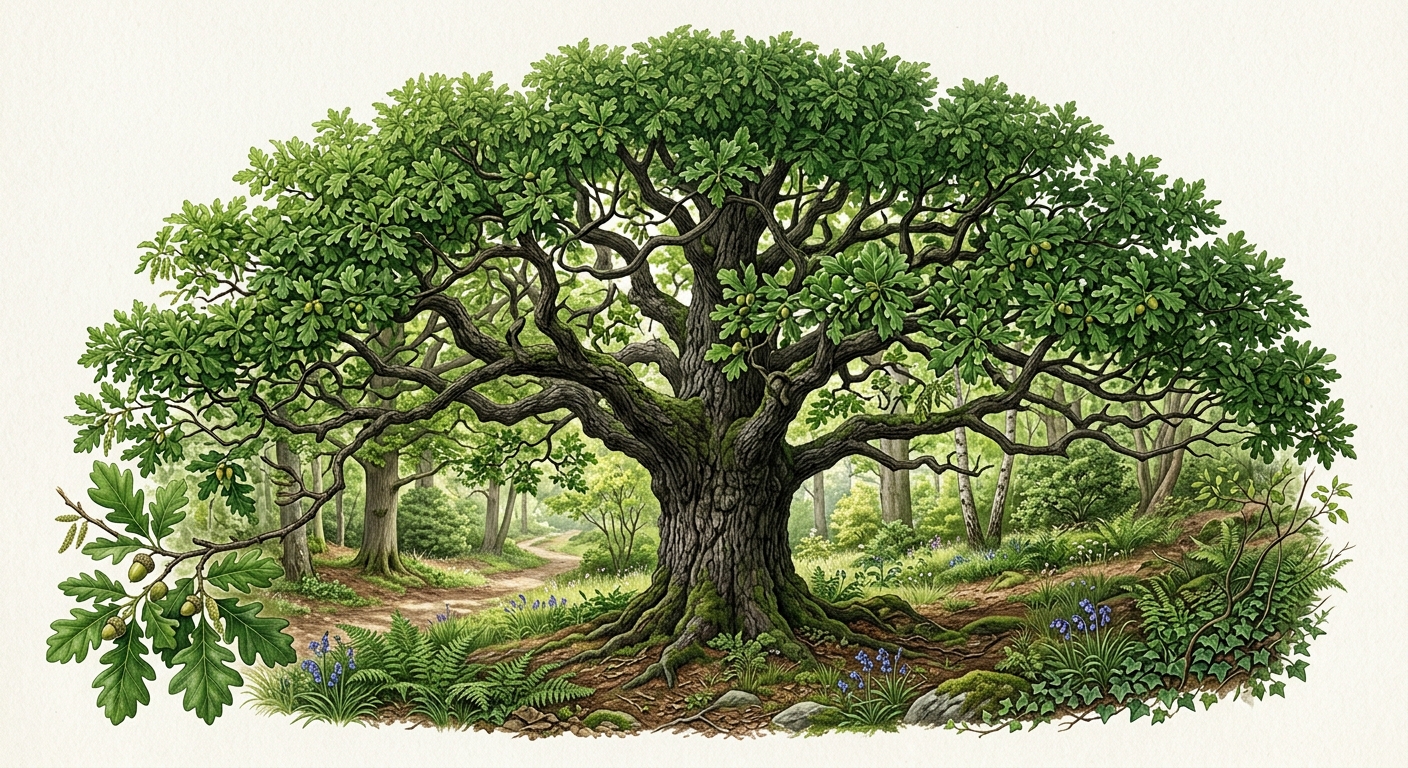
Quercus robur, commonly known as the English oak or pedunculate oak, is a large deciduous tree native to most of Europe and parts of western Asia. This long-lived species is renowned for its strength, durability, and cultural importance throughout European history.
Overview
The English oak (Quercus robur) is a majestic deciduous tree that can reach heights of 20-40 meters with a broad, spreading crown. It is one of the most important native tree species in Europe, forming the dominant canopy species in many temperate broadleaf forests. The species is characterized by its deeply lobed leaves, acorns borne on long stalks (peduncles), and rugged, deeply fissured bark that develops with age. This oak species has played a pivotal role in European ecosystems for millennia, supporting hundreds of insect species, birds, mammals, and fungi. The tree's wood is exceptionally strong and durable, historically prized for shipbuilding, construction, and furniture making. Quercus robur is remarkably long-lived, with some specimens documented to exceed 1,000 years of age. The English oak thrives in deep, fertile soils and exhibits remarkable adaptability to various moisture conditions, from well-drained uplands to periodically flooded bottomlands. It is a keystone species in European woodland ecosystems, with its acorns providing crucial food for wildlife including jays, squirrels, deer, and wild boar. The tree's longevity and ecological importance have made it a symbol of strength and endurance across European cultures.
How to identify
Quercus robur is identified by its characteristic lobed leaves (7-14 cm long) with 3-7 pairs of rounded lobes and distinctive auricles (small ear-like projections) at the leaf base where it meets the very short petiole (1-7 mm). The bark is grayish-brown and becomes deeply fissured with age. Acorns are 1.5-4 cm long, borne in clusters of 1-4 on long stalks (peduncles) 3-7 cm in length, distinguishing it from sessile oak. Mature trees develop a broad, irregular crown with massive, spreading branches. Winter buds are clustered at twig tips, ovoid, and light brown.
Habitat
Quercus robur inhabits mixed deciduous woodlands, forest edges, hedgerows, and parklands. It prefers deep, fertile, clay or loamy soils with good moisture retention but tolerates a wide range of soil types and pH levels. The species thrives in lowland areas and valleys, often found in floodplains and areas with seasonally high water tables, though it also grows on drier sites at elevations up to 1,000 meters.
Distribution
Native to most of Europe from the British Isles and Iberian Peninsula eastward to the Ural Mountains, and from Scandinavia south to the Mediterranean, Asia Minor, and the Caucasus. The species has been widely planted beyond its native range in temperate regions worldwide, including North America, Australia, and New Zealand.
Diet
Requires full sun to partial shade and adapts to a wide range of soil types, preferring deep, fertile, moisture-retentive loams with pH 5.0-7.5. The species has moderate to high nutrient requirements and benefits from organic-rich soils. It develops a deep taproot system that accesses water and nutrients from lower soil horizons, making it relatively drought-tolerant once established.
Behavior
Quercus robur exhibits determinate shoot growth, producing a single flush of leaves in spring. The tree develops a strong central trunk and spreading branch architecture, often with heavy lateral limbs in open-grown specimens. It forms mycorrhizal associations with numerous fungal species that enhance nutrient uptake. The species demonstrates moderate growth rates (30-60 cm per year when young) and can resprout vigorously from the stump if cut, a trait utilized in traditional coppicing management.
Reproduction & life cycle
The species is monoecious, bearing separate male and female flowers on the same tree. Male catkins appear in late April to May, releasing abundant wind-dispersed pollen, while small female flowers develop in leaf axils. Acorns mature in a single season (September-October) and are dispersed by gravity, water, and animals, particularly jays and squirrels that cache them. Trees typically begin producing acorns at 40-60 years of age in closed forests, earlier (20-30 years) in open conditions. Mast years (heavy acorn crops) occur irregularly every 4-10 years.
When to look
Best observed in spring (April-May) during leaf emergence and flowering, and autumn (September-October) when acorns mature and leaves turn golden-brown before falling. Summer displays full canopy. Winter reveals characteristic branching pattern and deeply fissured bark.
Cultural significance
The English oak holds profound cultural significance across Europe, symbolizing strength, endurance, and national identity, particularly in England where it is the national tree. Its timber was essential for shipbuilding, including Nelson's HMS Victory, and construction of medieval buildings and cathedrals. The species features prominently in Celtic and Germanic mythology, sacred groves, and folklore. Oak galls were historically used to produce tannic acid for ink and leather tanning. The tree remains a symbol in heraldry, literature, and continues to be planted ceremonially to mark significant events.
Similar species
- Quercus petraea (Sessile oak) - acorns without stalks, longer leaf petioles
- Quercus pubescens (Downy oak) - hairy leaves and twigs
- Quercus cerris (Turkey oak) - longer, narrower leaf lobes and mossy acorn cups
Watch on YouTube
Search YouTube for "Quercus robur English oak tree identification wildlife"Share notes, corrections, or add local knowledge. Text · Images · Videos · Links.