
jackfruit tree
Community-requested profile — enriching…
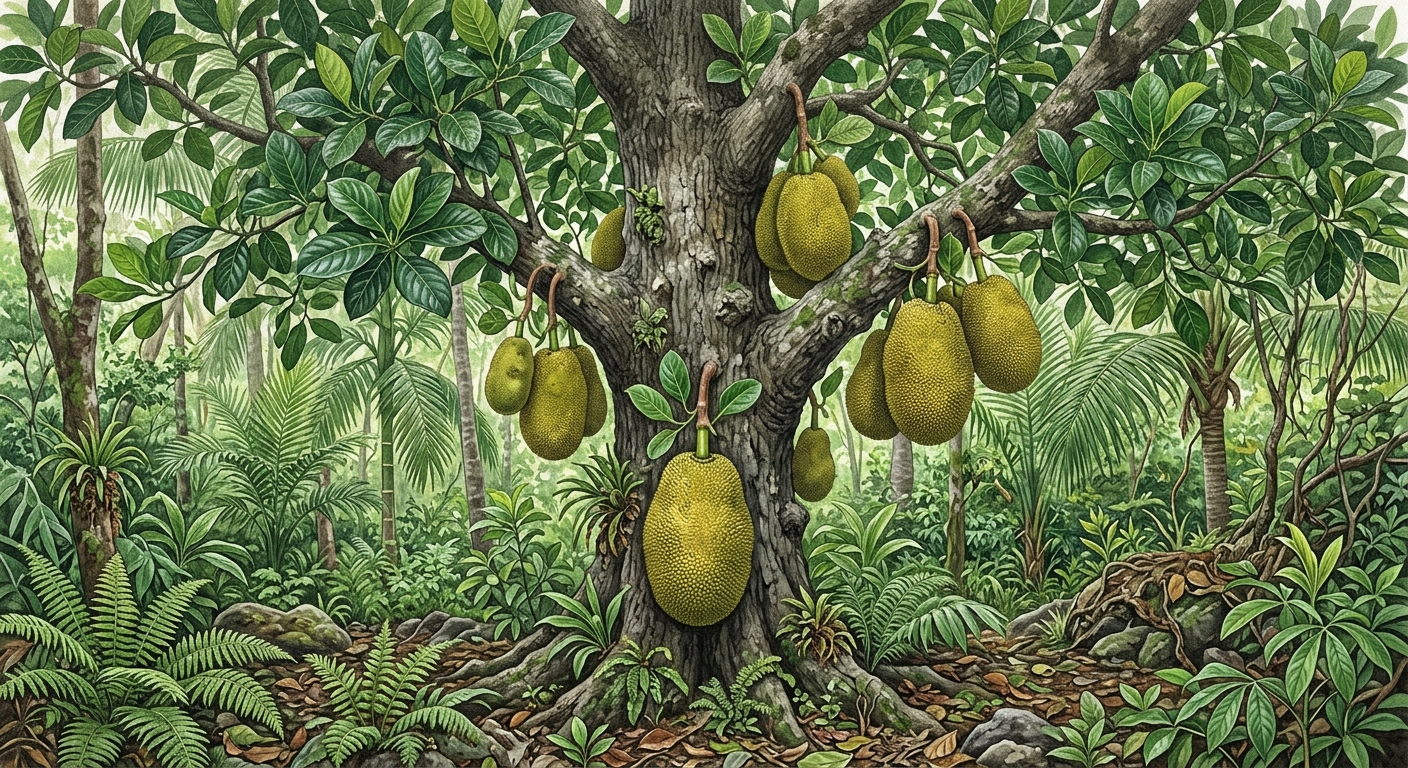
The jackfruit tree (Artocarpus heterophyllus) is a tropical evergreen tree native to South and Southeast Asia, renowned for producing the largest tree-borne fruit in the world. It has been cultivated for thousands of years for its nutritious fruit, timber, and latex.
Overview
The jackfruit tree is a member of the Moraceae family and is closely related to breadfruit, figs, and mulberries. Native to the Western Ghats of India, it has been widely cultivated throughout tropical regions of Asia, Africa, and the Americas. The tree is economically and nutritionally important, with its massive fruits weighing up to 55 kg (120 lbs) and reaching lengths of 90 cm (35 inches). Jackfruit trees are medium to large evergreens that can reach heights of 15-25 meters with a dense, spreading canopy. The tree produces white latex in all its parts, which has been traditionally used for various purposes. Its wood is valued for furniture and construction, being termite-resistant and taking an attractive golden-brown polish. The fruit is highly versatile, with unripe jackfruit used as a vegetable and ripe fruit consumed fresh or processed. The large seeds are also edible when cooked. Jackfruit has gained global attention as a sustainable crop due to its high yield, nutritional value, and potential as a meat substitute in vegetarian cuisine. The tree is well-adapted to tropical lowland environments and can tolerate a range of soil conditions, though it thrives in deep, well-drained soils. It is relatively easy to cultivate and can begin bearing fruit within 3-8 years from planting, continuing to produce for decades.
How to identify
The jackfruit tree has large, leathery, dark green leaves that are oval to elliptic in shape, measuring 10-25 cm long. Leaves are entire (without lobes) and glossy on the upper surface. The bark is brown to gray-brown, relatively smooth on young trees but becoming slightly rough with age. All parts exude sticky white latex when cut. The tree has a dense, pyramidal to rounded crown. The massive, spiny fruits develop directly on the trunk and main branches (cauliflory), covered with numerous hexagonal, pointed protuberances. Flowers are small, greenish, and borne in dense clusters on short stalks emerging from the trunk and older branches.
Habitat
Jackfruit trees thrive in humid tropical lowlands, preferring areas with temperatures between 25-35°C and annual rainfall of 1500-2500 mm. They grow best in deep, well-drained alluvial or volcanic soils with good moisture retention. The species is found in home gardens, orchards, mixed plantations, and as a component of agroforestry systems. While preferring lowland conditions, jackfruit can grow at elevations up to 1600 meters in equatorial regions.
Distribution
Native to the Western Ghats of India, jackfruit has been cultivated throughout South Asia, Southeast Asia (including Bangladesh, Myanmar, Thailand, Malaysia, Indonesia, and the Philippines), southern China, and Sri Lanka. It has been introduced and naturalized in tropical Africa, the Caribbean, Central and South America, Hawaii, and parts of Oceania. India, Bangladesh, and Thailand are the major producers globally.
Diet
Jackfruit trees require full sun exposure for optimal fruit production. They prefer deep, well-drained, slightly acidic to neutral soils (pH 6.0-7.5) rich in organic matter. The trees have moderate water requirements, needing regular moisture especially during flowering and fruit development, but are sensitive to waterlogging. They benefit from organic mulching and periodic applications of balanced fertilizers containing nitrogen, phosphorus, and potassium, along with micronutrients.
Behavior
Jackfruit exhibits cauliflory, with fruits developing directly on the trunk and major branches. Trees typically flower during dry periods, with fruit development occurring over the subsequent rainy season. The species shows some drought tolerance once established but requires adequate water for fruit production. Trees can produce 100-200 fruits annually when mature. The heavy fruits develop over 3-8 months from flowering to maturity, requiring strong structural branches. Young trees have a single dominant trunk, while older specimens develop spreading lateral branches forming a rounded canopy.
Reproduction & life cycle
Jackfruit trees are monoecious, bearing separate male and female flowers on the same tree. Male flowers appear in oblong clusters on new growth, while female flowers form compact cylindrical or rounded heads on the trunk and older branches. Pollination is primarily by wind and insects. The compound fruit (syncarp) develops from hundreds of individual flowers that fuse together. Seeds are enclosed within fleshy, aromatic bulbs (arils). Each fruit contains 100-500 large seeds. Trees grown from seed begin bearing in 3-8 years, while grafted trees may fruit in 2-3 years. Seeds remain viable for only a few weeks and germinate readily in 3-8 weeks when fresh.
When to look
Flowering typically occurs during dry periods (varies by region: January-March in some areas, May-August in others). Fruit ripens 3-8 months after flowering, with main harvest seasons varying regionally (March-June and September-December in India; year-round in equatorial regions with staggered fruiting).
Cultural significance
Jackfruit holds immense cultural and economic importance across South and Southeast Asia. In Kerala, India, it is considered the state fruit and features prominently in traditional cuisine. The unripe fruit is a staple vegetable curry ingredient, while ripe fruit is eaten fresh or made into chips, preserves, and desserts. The seeds are roasted or boiled as snacks. In traditional medicine, various tree parts are used to treat ailments ranging from digestive issues to skin diseases. The latex has been used as a birdlime and adhesive. In Buddhist and Hindu traditions, the tree is often planted near temples. Jackfruit wood is prized for making furniture, doors, and musical instruments. Recently, jackfruit has gained international recognition as a sustainable, plant-based meat alternative.
Similar species
- Breadfruit (Artocarpus altilis)
- Chempedak (Artocarpus integer)
- Marang (Artocarpus odoratissimus)
Watch on YouTube
Search YouTube for "jackfruit tree Artocarpus heterophyllus growing harvesting"Share notes, corrections, or add local knowledge. Text · Images · Videos · Links.