
Bamboo
Fastest-growing woody grass in the world
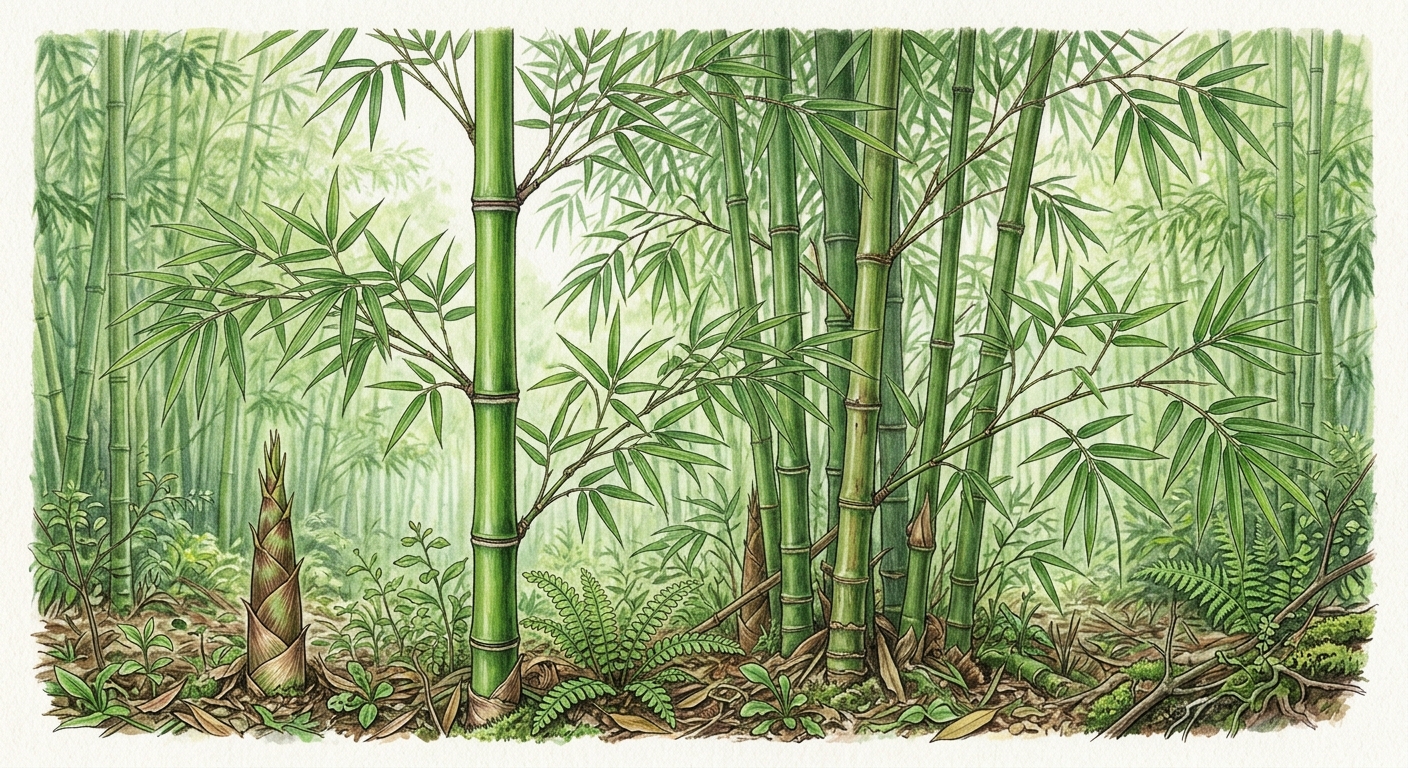
Bambusoideae is a diverse subfamily of perennial grasses comprising over 1,400 species commonly known as bamboo. These fast-growing plants are found primarily in tropical and subtropical regions and are distinguished by their woody, hollow culms and unique flowering cycles.
Overview
Bamboo (Bambusoideae) is a subfamily of flowering perennial evergreen plants in the grass family Poaceae. Despite often being called trees, bamboos are actually giant grasses characterized by woody, hollow stems called culms that are segmented by nodes. The subfamily includes over 1,400 species in approximately 115 genera, ranging from small herbaceous plants to giant timber bamboos that can exceed 30 meters in height. Bamboos exhibit remarkable growth rates, with some species capable of growing up to 91 cm (36 inches) within a 24-hour period under ideal conditions, making them among the fastest-growing plants on Earth. They are divided into two major groups: woody bamboos (tribe Bambuseae) and herbaceous bamboos (tribe Olyreae). Most bamboos form extensive underground rhizome networks that allow them to spread vegetatively and survive environmental disturbances. Bamboos play crucial ecological roles in their native habitats, providing food and shelter for numerous species including giant pandas, red pandas, mountain gorillas, and various bird species. They also serve important ecosystem functions such as preventing soil erosion, sequestering carbon, and maintaining watershed health. The economic importance of bamboo is substantial, with applications ranging from construction materials and textiles to paper production and culinary uses. One of the most distinctive features of bamboo is its unusual flowering behavior. Many species exhibit gregarious flowering, where all plants of the same species flower simultaneously regardless of geographic location, often after decades or even over a century of vegetative growth. Following this mass flowering event, the bamboo plants typically set seed and die, a phenomenon known as monocarpy.
How to identify
Bamboo is identified by its distinctive hollow, cylindrical culms (stems) divided into segments by solid nodes, from which branches and leaves emerge. The culms range from pencil-thin to over 30 cm in diameter and can grow from less than 1 meter to over 30 meters tall depending on species. Leaves are typically lanceolate (lance-shaped) with parallel venation, arranged alternately on branches, and vary from 2-30 cm in length. The culm sheaths, which protect young shoots, are papery or leathery and fall away as the culm matures. Bamboo can be distinguished from other grasses by its woody culms, branching pattern at nodes, and persistent woody structure. Color varies from green to yellow, black, or striped depending on species.
Habitat
Bamboo inhabits diverse environments including tropical and subtropical forests, temperate woodlands, and mountainous regions up to 4,000 meters elevation. Most species prefer moist, well-drained soils in areas with high humidity and regular rainfall. Tropical bamboos thrive in lowland rainforests, while temperate species occupy hillsides and mountain slopes in regions with distinct seasons.
Distribution
Bamboo is native to all continents except Europe and Antarctica, with the greatest diversity found in East and Southeast Asia, particularly China, which hosts over 500 species. Significant populations occur throughout tropical and subtropical regions of Asia, Africa, Australia, and the Americas. Temperate bamboos are found in regions of China, Japan, and parts of the Americas. Many species have been introduced worldwide for ornamental, agricultural, and commercial purposes.
Diet
Bamboo requires well-drained, slightly acidic to neutral soils (pH 5.5-6.5) rich in organic matter and nitrogen. Most species prefer partial shade when young but tolerate full sun once established. They need consistent moisture, particularly during the growing season, but cannot tolerate waterlogged conditions. Bamboos are heavy feeders and benefit from regular applications of nitrogen-rich fertilizers or organic compost to support their rapid growth.
Behavior
Bamboo exhibits remarkable vegetative growth through underground rhizome systems, which are classified as either running (leptomorph) or clumping (pachymorph). Running bamboos spread aggressively through long rhizomes that can extend several meters annually, while clumping bamboos grow in tight clusters with short rhizomes. New shoots (culms) emerge during the growing season and reach their full height within a few months, then harden and develop branches over subsequent years. Culms do not increase in diameter after initial emergence. Bamboo forests create dense shade and produce substantial leaf litter that enriches soil.
Reproduction & life cycle
Bamboo reproduces both vegetatively through rhizomes and sexually through seeds following flowering events. The flowering cycle is highly unusual and species-specific, with intervals ranging from annual to over 120 years. Many species exhibit gregarious monocarpic flowering, where all individuals of a species flower simultaneously worldwide, produce seeds, and then die. This synchronized flowering occurs at genetically predetermined intervals regardless of environmental conditions. Seeds germinate readily but seedlings grow slowly compared to vegetative propagation. Most bamboo cultivation relies on division of rhizomes or culm cuttings.
When to look
New shoots typically emerge during spring and early summer (wet season in tropical areas), reaching full height within 3-4 months. This is the best time to observe rapid growth and harvest edible shoots. Flowering is unpredictable and species-specific, occurring at genetically determined intervals rather than seasonally.
Cultural significance
Bamboo holds immense cultural significance across Asia, symbolizing strength, flexibility, and resilience in Chinese, Japanese, and other Asian philosophies. It is one of the 'Four Gentlemen' in Chinese art and features prominently in traditional paintings, literature, and gardens. Bamboo has over 1,500 documented uses including construction materials, scaffolding, furniture, textiles (bamboo fiber), paper, musical instruments, weapons, and culinary applications (bamboo shoots). Traditional medicine utilizes various bamboo parts for treating infections, inflammation, and other ailments. In many cultures, bamboo represents prosperity, longevity, and virtue.
Similar species
- Giant reed (Arundo donax)
- Giant cane (Arundinaria gigantea)
- Horsetail (Equisetum species)
Watch on YouTube
Search YouTube for "bamboo forest growth documentary"Share notes, corrections, or add local knowledge. Text · Images · Videos · Links.